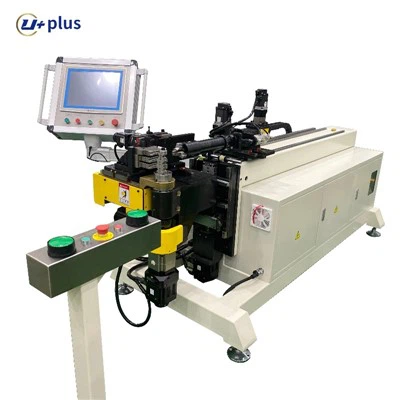
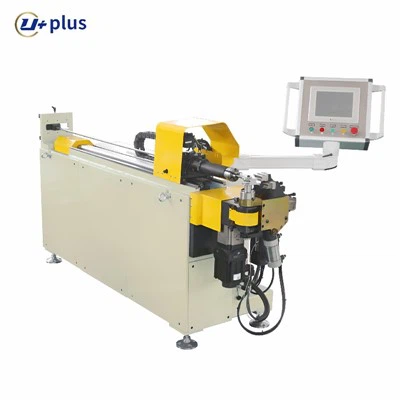
A CNC tube bending machine consists of three major components: a mechanical system, a hydraulic system, and a single-chip microcomputer (MCU), PLC, or PC control system. The mechanical component primarily comprises a tube rotating and clamping device, a tube bending transmission, a booster, a bed, and a bending die fixture. CNC tube bending machines utilize a three-coordinate positioning control system. Tube bending is achieved through bending motion commands (NC commands) controlling the motion of the three coordinate axes. The digital code information includes YBC data programs or vector coordinate point programs, the machine's bending speed, the clamping force of the clamping block and booster, and the amount of springback. Therefore, the control system implements digital control over the Y, B, C, and X axes. The primary control parameters for the feed axis (Y-axis) are displacement, displacement velocity, and acceleration. In typical CNC tube bending machine structures, Y-axis motion refers to the linear reciprocating motion of the feed carriage along the bed. This motion is achieved by the machine's AC servo motor driving the meshing of gears and racks. Motion accuracy is achieved by a photoelectric encoder and a tachometer motor, which feed displacement and velocity signals to the computer for closed-loop control. ② The rotation axis (B-axis) controls the rotation angle, angular velocity, and angular acceleration. Closed-loop control primarily utilizes backlash-free gear sampling as feedback signals, driving the tube blank to achieve spatial rotation perpendicular to the Y-axis. ③ The control parameters for the bending axis (C-axis) are bending force, displacement, velocity, and acceleration. A hydraulic cylinder drives a chain system to rotate the bending arm, whose rotation, bending, and return strokes are precisely controlled by an electro-hydraulic servo system. Furthermore, the adjustment axis (X-axis), perpendicular to the Y-C plane, also requires control of displacement, velocity, and acceleration.
 English
- English
- Français
- Deutsch
- 日本語
- Italiano
- Español
- Português
- русский
- Latviešu
- Gaeilgenah Éireann
- Việt Nam
- 한국어
- slovenščina
- Indonesia
- Malti
- فارسی
- Bai Miaowen
- עברית
- Čeština
- dansk
- বাংলা
- Norsk
- hrvatski
- Eesti
- Polski
- українська
- România limbi
- हिंदी
- Türkçe
- Ελληνικά
- Български
- عربي
- ไทย
- Svenska
- bosanski
- suomi
- Melayu
- Cymraeg
- Kreyòl Ayisyen
- Català
- íslenska
- Nederlands
- O'zbek
- magyar
- Srbija jezik (latinica)
- Lietuvių
- slovenčina
- اردو