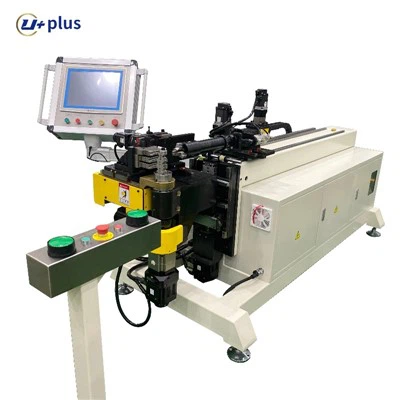
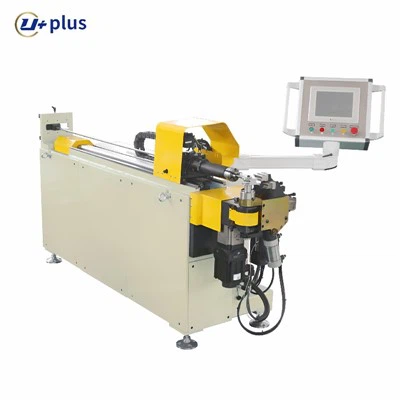
The differences between a tube end forming machine and a metal forming machine are as follows:
1. Functional Positioning and Processing Scope
Tube End Forming Machines
Specialize in processing the ends of metal pipes, capable of achieving complex shapes such as flaring, shrinking, bulging, and ribs, meeting the sealing, strength, and aesthetic requirements of pipe joints. For example, automotive fuel pipes require flaring to ensure a tight connection to the engine, while air conditioning copper pipes require shrinking to fit the compressor interface.
Typical Applications: Automotive Manufacturing (fuel and water pipes), Air Conditioning Systems (Copper Pipe Connections), Solar Energy Equipment (Pipe Sealing), and Medical Equipment (Surgical Tube Forming).
Metal Forming Machines
Broadly speaking, they encompass a variety of processes for plastic processing of metal materials, including stamping, bending, folding, and stretching. Processing targets include sheet metal, profiles, and pipes. Their functionality focuses on manufacturing various metal components, rather than simply processing pipe ends.
Typical Application Scenarios: Automotive Manufacturing (body panels), Mechanical Manufacturing (flanges, brackets), Electronics (mobile phone mid-frames), Construction (steel structural connectors).
2. Technical Principles and Core Structure
Tube End Forming Machine
Technical Principle: External force is applied to the tube end using a hydraulic system or mechanical pressure, combined with a mold to achieve shape change. Some models utilize heat softening technology (such as high-frequency induction heating) to assist in forming and enhance material plasticity.
Core Structure:
Mold System: Multi-station molds support process switching for flaring, shrinking, and bulging. Mold accuracy directly impacts forming quality.
Hydraulic System: The main cylinder provides forming pressure, the compression cylinder secures the tube, and the shift cylinder switches between stations, ensuring stable processing.
CNC System: Parameters are set via a touchscreen to control processing accuracy (e.g., coaxiality error must be less than 0.1mm) and automated processes (e.g., automatic counting and feeding).
Metal Forming Machine
Technical Principle: Metal shapes are transformed through processes such as stamping, bending, and stretching. For example, stamping applies pressure to the sheet material through a die, causing it to plastically deform; bending uses rollers or dies to bend the profile into a specific angle.
Core Structure:
Stamping Mechanism: Consists of a punch, die, and pressure source (hydraulic or mechanical), suitable for high-speed sheet metal forming.
Bending Mechanism: Rollers, clamps, and a drive system work together to achieve precise bending of the profile.
Control System: PLC or CNC systems support multi-process linkage and parameter adjustment, improving processing efficiency.
3. Industry Applications and Market Positioning
Tube End Forming Machines
Industry Characteristics: Primarily serving tube-intensive industries such as automotive, air conditioning, and solar energy, market demand is closely tied to the expansion of downstream industries. For example, the increasing complexity of piping systems in new energy vehicles is driving demand for high-precision tube end forming equipment.
Technological Trends: Developing towards high precision and multi-process integration, such as supporting complex processes like grooving and chamfering, to meet the stringent tube end forming requirements of industries such as aerospace.
Metal Forming Machines
Industry Characteristics: Widely applicable, with a large market potential, but also intensifying competition. The automotive and electronics industries are the primary demand drivers, and the high-end market demands extremely high equipment precision and stability.
Technology Trends: Intelligence and automation are key areas of focus, such as the introduction of AI algorithms to optimize stamping paths or the use of the Internet of Things to enable remote monitoring and fault warnings.
4. Comparison of Typical Processes
Tube End Forming Machines
Flaring: The end of a tube is expanded outward to form a bell-shaped opening for pipe connections or sealing.
Necking: The end of a tube is contracted inward to reduce its diameter to accommodate other component interfaces.
Bulging: A localized bulge is created on the end of a tube to enhance structural strength or install seals.
Rib Forming: Circular ribs are pressed into the end of a tube to increase tensile strength and joint stability.
Metal Forming Machines
Stamping: Pressure is applied to a sheet material through a die, causing plastic deformation, allowing for the production of complex shapes.
Bending: The profile is bent to a specific angle using rollers or dies. This process is suitable for manufacturing structural components such as frames and brackets.
Stretching: A process that applies tension to sheet metal, reducing its thickness and increasing its surface area. This process is used to produce deep-drawn parts (such as automotive fuel tanks).
5. Purchasing Recommendations
Tube End Forming Machine Selection: If your needs focus on tube end processing (such as automotive fuel pipes and air conditioning copper pipes), consider mold compatibility, hydraulic system stability, and CNC precision. For example, high-frequency induction heating can enhance material plasticity and is suitable for processing high-strength alloy tubes.