How Integrated Machines Simplify Coil-Fed Copper Tube Processing for HVAC Components
Copper tubes are widely used in air conditioning systems, refrigeration equipment and heat exchangers. Depending on the product design, these tubes may require several processing operations before they are ready for assembly.
A typical manufacturing process can include tube straightening, fixed-length cutting, expanding, reducing, bending and automatic unloading.
Traditionally, these operations may be completed on separate machines. However, when production volume increases, moving workpieces between different machines can create unnecessary handling time, additional positioning operations and production bottlenecks.
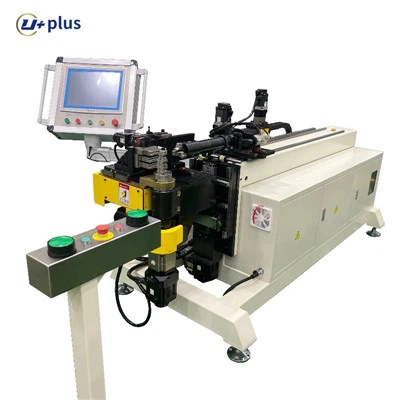
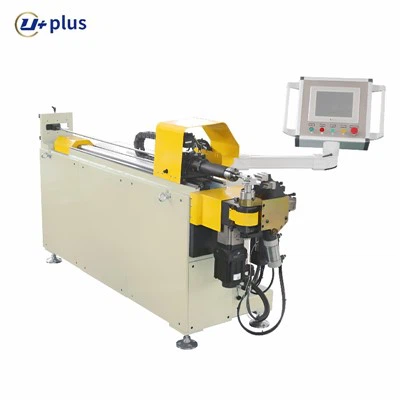
Integrated copper tube processing machines offer another approach by combining multiple operations into one coordinated manufacturing system.
1. Starting with Coil-Fed Copper Tube Material
For manufacturers using copper tube coils, the production process begins with a pay-off and feeding system.
The tube is guided from the coil into the processing machine. Because coiled material naturally has a curved shape, straightening and roundness correction may be required before further processing.
A suitable straightening system helps prepare the tube for accurate feeding and downstream operations.
Important considerations include:
Tube material and temper
Outer diameter
Wall thickness
Coil dimensions and weight
Initial tube condition
Required straightness and roundness
Stable material preparation provides a better foundation for consistent cutting, forming and bending.
2. Fixed-Length Feeding and Tube Cutting
After straightening, the tube is fed to the programmed length.
Servo-controlled feeding systems can position the tube according to the required product dimensions. A suitable cutting mechanism then separates the tube into individual workpieces.
Cutting quality is important because poor end conditions may affect subsequent tube-end forming and assembly.
Manufacturers should pay attention to:
Cutting length accuracy
Cut-end squareness
Burr formation
Surface scratches
Material deformation
Repeatability between production cycles
For continuous production, integrating feeding and cutting into the same machine can reduce repeated manual measurement and handling.
3. Integrating Tube-End Forming Operations
After cutting, many HVAC copper tube components require additional processing at one or both ends.
Common operations include:
Tube expanding
Tube reducing
Straight punching
Rotary punching
End shaping
Other customized forming operations
These processes create the required connection geometry for downstream assembly and brazing.
When tube-end forming is integrated with cutting, the workpiece can move through the required operations without being repeatedly removed and repositioned on separate machines.
Depending on the product design, different tooling stations can be configured for front-end and rear-end processing.
The tooling arrangement should be determined by the actual product drawing, tube dimensions and required forming geometry.
4. CNC Bending Within the Same Production System
Many HVAC components require tubes with specific bending angles, radii and spatial orientations.
CNC bending technology allows manufacturers to control feeding length, tube rotation and bending angle through programmed movements.
When bending is integrated with cutting and end forming, the machine can complete several operations in a coordinated sequence.
This approach is particularly useful for products with stable geometry and repeated production requirements.
For different product models, manufacturers should also consider tooling replacement, program management and changeover time.
5. A More Coordinated Production Flow
A typical integrated coil-fed copper tube processing route may include:
Coil loading and tube feeding
Straightening and roundness correction
Servo-controlled fixed-length feeding
Tube cutting
Front-end processing
Pull-off separation
Rear-end processing
CNC bending
Automatic unloading
The exact sequence and automation level depend on the selected machine configuration.
By connecting these operations, manufacturers can reduce repeated handling and make the production process more continuous.
6. Key Advantages of Integrated Tube Processing Machines
Reduced Material Handling
Combining several operations reduces the need to transfer workpieces between independent machines.
Improved Process Coordination
Feeding, cutting, end forming and bending can follow a predefined processing sequence.
More Consistent Positioning
Reducing repeated clamping and manual repositioning helps maintain the relationship between different processing operations.
Better Use of Factory Space
Combining multiple functions into one machine may reduce the floor space required compared with several independent machines.
Simplified Production Management
CNC and PLC control systems can manage processing programs and machine movements according to the equipment configuration.
Actual productivity depends on product geometry, tooling, cycle time, loading method and equipment stability. Integration should therefore be evaluated against the complete manufacturing requirement.
7. What Should You Consider Before Selecting an Integrated Machine?
Not every copper tube component requires the same processing sequence.
Before selecting equipment, manufacturers should prepare the following information:
Tube material and material condition
Tube outer diameter and wall thickness
Straight tube or coil-fed material
Coil dimensions and loading requirements
Finished tube length
Front-end and rear-end forming requirements
Bending radius and bending angles
Product drawings or physical samples
Target production capacity
Required changeover frequency
Automatic loading and unloading requirements
These details help engineers determine which operations can be integrated and what machine configuration is appropriate.
For different tube sizes and product geometries, dedicated tooling and process verification may be necessary.
Sample testing is an important step before confirming the final equipment specification.
8. Applications in HVAC and Refrigeration Manufacturing
Integrated copper tube processing systems can be considered for different component manufacturing applications, including:
Air conditioning copper tube assemblies
Refrigeration system pipe components
Heat exchanger connecting tubes
Refrigerator and cooling equipment components
Automotive air-conditioning pipes
Other formed copper and aluminum tube products
The final equipment configuration should always be based on the customer's actual product requirements.
Conclusion
For HVAC and refrigeration manufacturers, production efficiency depends not only on the speed of individual machines but also on how smoothly each processing operation connects with the next.
By integrating straightening, cutting, tube-end forming and CNC bending, manufacturers can reduce unnecessary handling and create a more coordinated production process.
UPLUS Smart Technology provides copper tube cutting machines, CNC tube bending machines, tube-end forming equipment and integrated processing solutions for HVAC, refrigeration and heat exchanger component manufacturing.
Our engineering team can evaluate product drawings, material specifications, processing requirements and target production capacity to recommend a suitable equipment configuration.
Contact UPLUS to discuss your copper tube processing project.
Website: www.uplusmart.com
Email: xiang@uplusmart.com
WhatsApp: +86 158 2412 2388