Why Burr-Free Tube Cutting Matters in HVAC Copper Tube Manufacturing
Copper tubes used in air conditioning, refrigeration and heat exchanger manufacturing often pass through several operations before becoming finished components.
A typical process may include cutting, end forming, bending, assembly, brazing and leak testing.
Tube cutting is one of the earliest operations in this sequence, so it is sometimes treated as a relatively simple step. In practice, poor cutting quality can create problems that continue throughout the rest of the production process.
Burrs, metal chips, tube-end deformation and inconsistent cut length can all affect downstream forming, assembly and joining.
For high-volume HVAC manufacturing, stable tube cutting is therefore an important foundation for consistent production.
1. Why Does Cut Quality Affect Downstream Operations?
After a copper tube is cut to length, its ends may still require additional processing.
Typical downstream operations include:
Expanding
Reducing
Flaring
Chamfering
End shaping
Bending
Insertion and assembly
Brazing
If the cut end is uneven or heavily burred, the tube may not locate correctly in subsequent tooling.
If metal chips remain inside the tube, additional cleaning may be required before assembly.
For air-conditioning and refrigeration components, internal cleanliness is often more important than it is for ordinary structural tubing.
Tube cutting should therefore be evaluated by more than whether the material has simply been separated. The condition of the tube after cutting matters as well.
2. Common Problems in Copper Tube Cutting
Internal and External Burrs
Worn tooling, unsuitable cutting parameters or insufficient tube support can produce burrs around the inside and outside edges of the tube.
Large burrs may interfere with component insertion and may also affect expanding, reducing or other tube-end forming operations.
Metal Chips
Saw cutting and certain mechanical cutting methods can generate chips.
If these particles enter the tube, manufacturers may need additional blowing, washing or cleaning operations before the component can move forward in production.
Tube-End Deformation
Thin-wall copper tubes can become oval, flattened or locally distorted when clamping, supporting or cutting forces are not properly controlled.
This changes the starting geometry for downstream forming operations.
Cut-Length Variation
The cutting process establishes one of the basic dimensions of the finished component.
If fixed-length feeding is inconsistent, the final assembly may still be dimensionally incorrect even when later bending and forming operations are accurate.
Surface Damage
Copper is relatively soft. Feeding and clamping systems can therefore scratch or mark the tube surface when they are not correctly designed or adjusted.
3. What Does Low-Burr or Chip-Reduced Cutting Mean?
Low-burr or chip-reduced cutting is not simply about producing a more attractive tube end.
The main objective is to reduce the effect of the cutting process on tube geometry, cleanliness and downstream manufacturability.
A good cutting result typically aims for:
Stable cut length
Good tube-end roundness
Minimal internal and external burrs
Minimal chips inside the tube
Limited end deformation
No unnecessary surface damage
The appropriate cutting method depends on tube diameter, wall thickness, material condition, production volume and the requirements of the next manufacturing operation.
The final equipment configuration should therefore be verified against the actual product.
4. Why Cutting Quality Matters for Tube-End Forming
Expanding and reducing operations are sensitive to the initial condition of the tube end.
If a tube is already oval or locally flattened after cutting, the forming tool must first compensate for this deformation before producing the required geometry.
This makes dimensional consistency more difficult to maintain.
Heavy burrs can also interfere with tooling and may contribute to:
Dimensional variation
Surface scratching
Local cracking
Increased tool wear
Unstable workpiece positioning
For production systems that connect cutting directly with end forming, stable tube-end quality becomes especially important.
5. Cutting Quality Also Affects Brazing Preparation
Many HVAC copper tube components are eventually joined by brazing.
Reliable brazing depends on more than the heating process itself.
Part dimensions, fit-up conditions, insertion depth, joint clearance and cleanliness all influence joint preparation.
Excessive cut-length variation can change the assembly position or insertion depth.
Tube-end deformation can affect the fit between mating components.
Chips or cutting contamination may also create additional cleaning work before assembly.
A stable cutting process therefore provides better conditions for downstream assembly and brazing.
6. Why Accurate Fixed-Length Feeding Matters
In high-volume production, cutting speed alone is not enough.
The machine must also feed the tube consistently to the required position.
Servo-controlled or other precision feeding systems can position material according to programmed dimensions and improve repeatability between parts.
For manufacturers producing multiple models, programmable length settings can also reduce repeated manual measurement and adjustment.
When cutting is integrated with straightening, end forming or CNC bending, unnecessary workpiece transfer and repositioning can be reduced further.
7. What Should Manufacturers Consider When Selecting a Tube Cutting Machine?
Before selecting equipment, manufacturers should confirm:
Tube material and temper.
Tube outside diameter and wall thickness.
Whether the raw material is straight tube or coil.
Required cut-length range.
Length tolerance.
Whether chips are acceptable.
Internal and external burr requirements.
Whether straightening is required.
Downstream expanding, reducing or other end-forming operations.
Whether CNC bending is required.
Target production cycle.
Automatic loading and unloading requirements.
Whether the cutting machine will be integrated with other equipment.
These factors influence the cutting method, feeding mechanism, clamping design and automation level.
8. Do Not Compare Cutting Machines by Speed Alone
A common purchasing mistake is to compare machines only by how many pieces they can cut per minute.
For HVAC copper tube production, manufacturers should evaluate the complete production flow.
In addition to cycle time, important factors include:
Length repeatability
Tube-end condition
Burr control
Internal chips
Tube deformation
Surface protection
Changeover efficiency
Compatibility with downstream processes
Maintenance and tooling replacement
A machine may cut very quickly, but if the parts then require extensive deburring, cleaning or reshaping, the total production process may not actually become more efficient.
The most useful cutting solution is one that helps the next operation run more smoothly and consistently.
Conclusion
Tube cutting is one of the first important quality-control points in HVAC tube manufacturing.
Stable length, good end condition, low burrs and reduced chip generation create a better starting point for end forming, bending, assembly and brazing.
For high-volume air-conditioning and refrigeration component production, tube cutting should be evaluated as part of the complete manufacturing process rather than as an isolated machine operation.
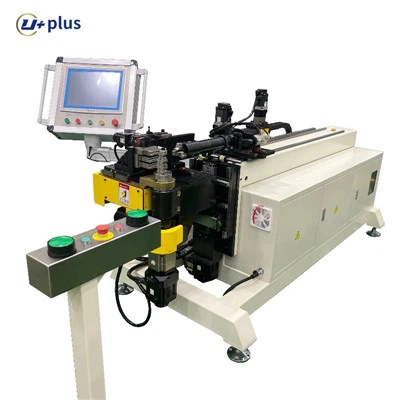
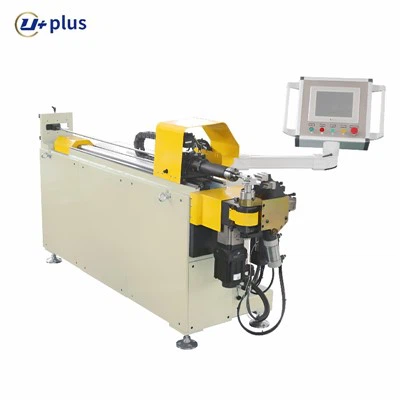
UPLUS Smart Technology provides tube cutting, straightening, tube-end forming, CNC bending and integrated automation solutions for HVAC and refrigeration component manufacturing.
Customers can provide tube specifications, product drawings, length requirements and target production capacity so that a suitable equipment configuration can be evaluated.
UPLUS Smart Technology
Website: www.uplusmart.com
Email: xiang@uplusmart.com
WhatsApp: +86 158 2412 2388