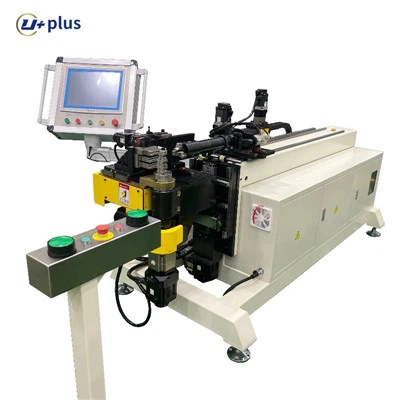
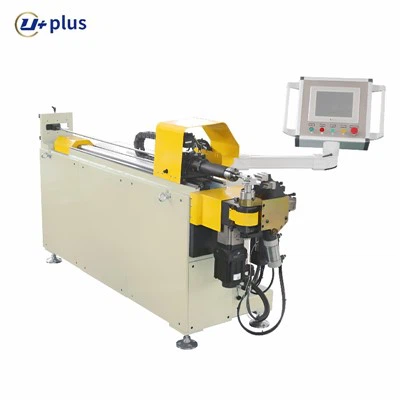
For many HVAC manufacturers, equipment investment traditionally follows a simple pattern: one machine for cutting, another for bending, another for tube end forming, and separate stations for brazing and inspection.
This approach still works well for many factories, especially when production volume is limited or products change frequently.
But as output increases, another problem begins to appear.
The individual machines may work efficiently, while the overall production process remains slow.
Parts wait between operations. Operators move material from one machine to another. Work-in-process inventory increases. Dimensional variation from one station can create problems at the next. When a defect is finally discovered, it may be difficult to identify where it originated.
This is why more HVAC manufacturers are beginning to evaluate integrated production cells rather than simply adding more standalone machines.
The Bottleneck Is Often Between Machines
A cutting machine may complete a tube in seconds. A CNC bending machine may also have sufficient capacity.
Yet the actual production cycle can still be much longer because the tube must be collected, stored, transferred, positioned again and sometimes manually checked before the next operation begins.
In high-volume HVAC production, these non-processing steps can become a major source of lost efficiency.
An integrated production cell is designed to reduce these interruptions.
Instead of treating cutting, bending, forming and inspection as completely independent processes, the equipment is arranged around a continuous production flow.
A typical HVAC tube processing cell may include:
Tube loading → straightening → fixed-length cutting → CNC bending → end forming → inspection → automatic unloading
For more complex components, brazing, leak testing or automated assembly can also be added.
Integration Is About More Than Labor Reduction
Automation is often discussed mainly as a way to reduce labor.
That is only part of the value.
For HVAC component manufacturers, one of the bigger advantages is process consistency.
Consider a copper tube that must be cut, bent and expanded before brazing.
If the cutting length varies, the bend position may shift.
If the bending position shifts, the tube may not fit correctly into the next fixture.
If the expanded diameter is unstable, joint clearance during brazing may change.
A problem created at the first process can therefore continue through several downstream operations.
When equipment is integrated, process parameters can be managed as part of one production sequence. This makes it easier to control the relationship between each operation rather than optimizing each machine separately.
Product Changeover Still Matters
A fully automatic line is not always the best answer.
This is particularly important in HVAC manufacturing, where one factory may produce many tube diameters, different bend geometries and multiple product models.
A highly dedicated line can achieve very high output, but it may become inefficient if production changes frequently.
For this reason, many manufacturers are moving toward flexible production cells rather than completely fixed automation.
Modern CNC and servo-controlled equipment can store multiple product recipes. Tooling can be designed for faster replacement, while fixtures and feeding systems can be adjusted for different components.
The goal is not maximum automation at any cost.
The better question is:
How much automation can be added while keeping the production line flexible enough for the actual product mix?
Which Processes Are Suitable for Integration?
Tube processing is one of the most practical areas for integration because several operations naturally follow one another.
Automatic feeding can be connected with cutting.
Cutting can be followed by CNC bending.
Bending can be followed by expanding, reducing, flaring or other end-forming operations.
For components with stable product geometry, automatic loading and unloading can reduce repeated manual positioning.
Inspection can then be added at critical points rather than waiting until the end of production.
In heat exchanger and refrigeration component manufacturing, other processes may also be integrated, including:
automatic brazing, dimensional inspection, leak testing, vision inspection, OK/NG sorting and production traceability.
However, the correct configuration depends heavily on the product.
A production cell for simple copper return bends is very different from a line producing complex air-conditioning pipe assemblies.
Quality Control Should Be Designed Into the Cell
One of the most useful changes in modern production planning is moving inspection closer to the process that creates the dimension being checked.
For example, bending accuracy should ideally be verified shortly after bending.
Tube end dimensions should be checked after forming.
Leak testing should be connected with brazing or final assembly when the product requires airtightness control.
This approach makes troubleshooting much easier.
If a problem is detected immediately after a process, operators can adjust the machine or tooling before a large quantity of defective parts is produced.
Integrated inspection also makes production data more useful.
With suitable controls, manufacturers can record product recipes, production quantities, inspection results, alarms and rejection data. Barcode or QR identification can also be introduced when product traceability is required.
When Does an Integrated Cell Make Sense?
Not every factory needs a complete automated line.
Standalone machines may still be the better choice for prototype production, small batches or highly variable products.
Integration becomes more attractive when several conditions appear together:
production volume is increasing, the same process route is repeated regularly, manual transfer is becoming a bottleneck, quality variation between operators is difficult to control, or the manufacturer needs better production data and traceability.
The decision should therefore start with the production process rather than with the equipment catalogue.
Before designing a cell, manufacturers should evaluate the product drawing, tube material, diameter and wall thickness, process sequence, target cycle time, model change frequency and required inspection standard.
From Equipment Purchasing to Process Planning
The HVAC equipment market is gradually moving away from simply asking, "Which machine do we need?"
A more useful question is becoming:
"What is the most efficient way to manufacture this component from raw tube to finished part?"
That change matters.
When cutting, bending, forming, brazing and inspection are considered together, manufacturers can identify bottlenecks that may not be visible when each process is evaluated independently.
The result does not always need to be a fully automatic production line.
Sometimes the best solution is a combination of several flexible machines connected by simple automated handling.
In other cases, a dedicated production cell can provide the consistency and capacity required for long-term mass production.
UPLUS Smart Technology provides equipment and customized manufacturing solutions for HVAC and refrigeration components, including tube cutting, CNC bending, tube end forming, brazing, leak testing, inspection and automation systems.
For a new production project, customers can provide product drawings, tube specifications, required capacity and current process information. The production route can then be evaluated before the equipment configuration is defined.