As competition in the air conditioning industry continues to increase, manufacturers need not only higher production capacity but also lower production costs, improved product quality, and stronger market competitiveness. Labor cost is one of the major expenses in manufacturing, making it a key focus for many air conditioning producers.
In traditional air conditioning manufacturing, many processes rely heavily on manual labor, including copper tube processing, material handling, pipeline brazing, assembly, inspection, and packaging. These operations require a large number of workers and are easily affected by operator experience, fatigue, and employee turnover, resulting in reduced efficiency and unstable quality.
Reducing labor costs does not simply mean reducing the number of workers. Instead, it means improving production efficiency through automation equipment, process optimization, intelligent management, and better production planning, creating a more efficient and stable manufacturing system.
1. Identify Major Labor-Intensive Processes
In air conditioning production, labor costs are usually concentrated in the following areas:
Raw material handling
Copper tube cutting and processing
Tube bending and forming
Manual brazing
Component assembly
Product inspection
Packaging and transportation
Production data recording
Among these processes, repetitive operations with high labor intensity and fixed cycle requirements are the best candidates for automation improvement.
For example, copper tube cutting, bending, expanding, and reducing operations require many operators when performed manually and are easily affected by human factors. Automated equipment can operate continuously while maintaining stable processing accuracy.
Therefore, the first step to reducing labor costs is identifying high-labor processes and prioritizing them for automation upgrades.
2. Replace Repetitive Manual Operations with Automated Equipment
Automation equipment is one of the most direct ways to reduce labor costs in air conditioning production.
In traditional manufacturing, one operator may be responsible for one machine or one workstation. Automated equipment can perform automatic feeding, positioning, processing, and inspection, allowing one operator to manage multiple machines.
Common automation equipment includes:
Automatic tube cutting machines
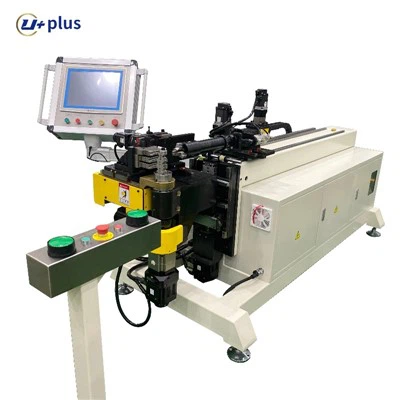
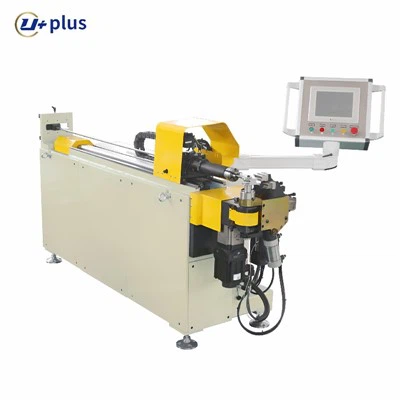
CNC tube bending machines
Automatic expanding and reducing machines
Multi-station processing equipment
Automatic brazing equipment
Robotic assembly systems
Automatic inspection systems
For example, an automated copper tube processing line can complete:
Automatic feeding → Tube cutting → Deburring → Tube bending → End forming → Inspection → Unloading
Compared with manual processing, automated solutions reduce operator requirements while improving production cycle time and product consistency.
3. Improve Automation Level in Copper Tube Processing
Copper tube processing is one of the most labor-intensive areas in air conditioning manufacturing.
Traditional processing may require operators to:
Measure tube length manually
Cut tubes manually
Bend tubes manually
Perform expansion manually
Inspect dimensions manually
These operations are not only inefficient but also highly dependent on operator experience.
Modern automated copper tube processing equipment can achieve:
Automatic feeding
CNC length control
Automatic bending compensation
Precision end forming
Online dimensional inspection
For high-volume air conditioning manufacturers, automated copper tube processing lines can significantly reduce labor requirements while also reducing material waste and rework costs.
4. Promote Automated Brazing Technology
Brazing is another process with relatively high labor requirements in air conditioning production.
Traditional flame brazing depends heavily on skilled operators. Brazing quality can be affected by:
Operator experience
Heating time
Flame position
Filler metal feeding amount
Working conditions
Automated brazing equipment can control:
Heating time
Heating power
Brazing position
Filler metal feeding
Cooling process
Common solutions include:
Automatic flame brazing
Induction brazing
Robotic brazing
Rotary table brazing systems
Automated brazing not only reduces labor requirements but also improves joint consistency and reduces rework caused by brazing defects.
5. Use Robots for Handling and Assembly
A large amount of labor time in air conditioning production is spent on material handling and repetitive assembly tasks.
Examples include:
Heat exchanger handling
Semi-finished product transfer
Large component installation
Product loading and unloading
These tasks are physically demanding but relatively standardized, making them suitable for robotic automation.
Robot systems can be used for:
Automatic loading and unloading
Component handling
Automatic assembly
Palletizing
Automatic packaging
By integrating robots, manufacturers can reduce manual handling, improve workplace safety, and maintain stable production cycles.
6. Optimize Production Layout to Reduce Inefficient Labor
Reducing labor costs is not only about upgrading equipment. Production flow and factory layout also play important roles.
Many companies have high labor costs not because they have too many processes, but because of:
Long material transfer distances
Poor workstation layout
Excessive waiting time between processes
Too much semi-finished inventory
Repeated manual operations
By redesigning production layouts, companies can reduce unnecessary movement and improve worker efficiency.
Optimization methods include:
Shortening distance between machines
Using automatic conveyor systems
Designing reasonable workstation numbers
Balancing production cycles
Reducing manual transportation
For example, U-shaped production lines allow operators to manage more equipment within a smaller area.
7. Reduce Quality Inspection Labor Through Automatic Inspection
Quality inspection often requires significant manpower, especially in high-volume production.
Traditional inspection may require operators to manually:
Measure dimensions
Check brazing joints
Inspect appearance
Perform leak tests
Record data
Automatic inspection systems can reduce repetitive inspection work.
Common inspection equipment includes:
Air tightness testing systems
Vision inspection systems
Dimensional inspection equipment
Online performance testing systems
Automatic inspection not only reduces inspection labor but also improves testing speed and data accuracy.
8. Improve Workforce Efficiency Through Digital Management
Reducing labor costs is not only about reducing production workers but also improving management efficiency.
MES production management systems can provide:
Automatic production data collection
Equipment status monitoring
Process parameter management
Quality traceability
Production planning management
Previously, production managers might need to manually collect output, quality, and equipment information. Digital systems can automatically generate data, allowing managers to control production more efficiently.
Through data analysis, companies can identify:
Low-efficiency processes
Equipment bottlenecks
Sources of waste
and make targeted improvements.
9. Use Flexible Automation to Reduce Changeover Costs
For companies producing multiple air conditioning models, frequent product changes can increase labor requirements.
Traditional changeovers require operators to:
Replace fixtures
Adjust equipment parameters
Test product dimensions
Modify production processes
Flexible automation equipment can reduce changeover time through:
CNC program switching
Quick tooling change systems
Modular fixtures
Automatic parameter loading
This allows manufacturers to maintain efficiency while reducing additional labor costs caused by product variation.
10. Labor Cost Reduction Requires Overall Planning
When upgrading automation systems, companies should not simply focus on reducing the number of workers. The goal should be improving overall production efficiency.
A reasonable automation solution should consider:
Product type
Annual production volume
Process complexity
Equipment investment cost
Workforce structure
Future expansion requirements
For standardized, high-volume air conditioning products, highly automated production lines are suitable.
For multi-product and small-batch manufacturing, flexible equipment and modular automation solutions are more appropriate.
The best solution is not necessarily the most automated one, but the one with the highest return on investment and the best match with the company's production model.
Conclusion
Reducing labor costs in air conditioning production requires improvements in equipment automation, production flow optimization, robotics, intelligent inspection, and digital management.
Through technologies such as automatic tube cutting, automatic bending, automated brazing, multi-station processing, robotic assembly, and intelligent inspection, manufacturers can reduce repetitive labor, improve production efficiency, and maintain stable product quality.
In the future, air conditioning manufacturing will continue to move toward automation, intelligent production, and reduced labor dependence. For air conditioning, refrigeration, HVAC, and heat pump manufacturers, properly planning automated production lines can not only reduce labor costs but also improve long-term manufacturing competitiveness.